The Grave That Grows Things
A Good Friday Reflection

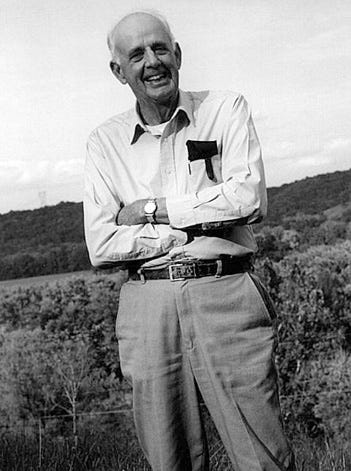
A friend shared this Wendell Berry poem with Donna last week
No, no, there is no going back.
Less and less you are
that possibility you were.
More and more you have become
those lives and deaths
that have belonged to you.
You have become a sort of grave
containing much that was
and is no more in time, beloved
then, now, and always.
And so you have become a sort of tree
standing over a grave.
Now more than ever you can be
generous toward each day
that comes, young, to disappear
forever, and yet remain
unaging in the mind.
Every day you have less reason
not to give yourself away.
-- Wendell Berry, A Timbered Choir: The Sabbath Poems
The poem was shared with a group of friends who had told stories over a long dinner about their lives — hopes, dreams, and disappointments. Donna read the poem to me from her group text — giving me a glimpse into the richness of these friendships. Berry wrote this poem when he was 58 years old — old enough to have experienced many losses, and yet young enough to have much life ahead.
The opening is worth reading again: “No, no, there is no going back. Less and less you are that possibility you were.”
I heard that and felt something move in my gut. Not grief exactly. But something closely related to grief — a feeling of deep resonance…a sense that Berry has found yet another way to describe our human experience with agricultural wisdom. Nearing my 6th decade of life I am fully aware that there more life behind me than in front of me. And the idea that the possibilities available to me are shrinking by the week…is a reality that I’ve been reckoning with for the past several years.
Here’s the thing about Good Friday that doesn’t get said enough: it isn’t only about the death of Jesus. It’s about all the deaths. The ones we carry around. The ones we’ve been hauling around so long we’ve stopped noticing the weight.
We have all experienced numerous deaths in our lives, in so many different ways. And I don’t mean only the physical deaths of people we know and love — though we have experienced many of those, and that grief has its own vast and difficult territory. But, Berry’s poem caused me to instantly call to mind, and ponder, the other deaths. The quieter ones. The dream you had at twenty-three that just sort of... stopped breathing somewhere around thirty-five. The version of your family you pictured on your wedding day. The faith you inherited that couldn’t quite hold up when real life got its hands on it. The parent you kept hoping your father might someday become. The person you were absolutely certain, without a doubt, you’d be by now. The career milestones you thought you would have put in your memory book by now. The financial security that still eludes you.
Those are deaths too. But nobody brings you a casserole. And nobody sends a card. You just carry them forward, decade after decade, tucked under your arm like something you can’t quite bring yourself to put down.
Berry calls us, “a sort of grave containing much that was and is no more in time, beloved then, now, and always.” His words are a bit haunting — beloved then, now, and always. The things that died in us were loved. That’s why they’re still in there. That’s why the grave belongs to us.
But then Berry does something that only a wise farmer and seasoned naturalist would do — he doesn’t leave us in the grave. He plants a tree on top of it.
And so we have become a sort of tree standing over a grave.
A tree whose roots go all the way down. Into all of it. The losses, the disappointments, the beloved wreckage of who we thought we’d be. And the tree doesn’t apologize for what’s buried beneath it. It doesn’t pretend the grave isn’t there. It roots into it. It grows because of what’s there — the many deaths we have endured become fertilizer for growth. This is Berry’s farm logic — and I think it might be the most honest thing I’ve encountered about resurrection, and he never once uses that word.
Every death becomes ground. Ground that holds. Ground that feeds. Ground that makes possible a kind of growth that simply couldn’t have happened any other way.
Here’s where I should tell you something about where I grew up.
I was raised in a non-denominational church — which, if you grew up in one, you already know that we were deeply certain about a great number of things. We loved Jesus. We loved the Bible. We loved each other, mostly. And we were, if I’m being honest, quietly convinced that we’d worked a few things out that the other churches in town missed the mark on.
The Catholic church down the street, for instance.
The crucifix bothered us. Jesus, still on the cross. Still just...hanging there. We found it — I don’t know — theologically imprecise. A little morbid, frankly. “He rose from the dead,” we’d remind each other, in the patient tone of people explaining something fairly obvious to someone who really should know better. Why leave him up there? That’s the whole point. Empty tomb. Sunday morning. He is risen.
What I didn’t see — what took me an embarrassingly long time to see — was what was happening every single time we confessed our sins. Every time someone laid out, carefully and with genuine love, the logic of what our failure had cost. The math was never quite spoken out loud, but it was always there, humming under everything like a furnace you can’t see but can always feel: your brokenness put him there. Your choices. Every time you fall short, this is what it takes.
We were re-crucifying him with our guilt. And calling it gratitude.
The people who taught me were good people, doing the best they knew, passing on what they’d been given. So was I. But somewhere in all that accumulated weight — the central focus on our sins, all that sorry again, all that I’ll try harder this time — something in me went quiet. And not the good kind of quiet.
The thing is, we never took Jesus off the cross either. We just didn’t hang a sculpture.
What I didn’t know then — what took years and a lot of reading and more than a few of my own quiet deaths to find — is that there’s another way to understand what happened on Good Friday altogether. A way that doesn’t run on shame and guilt as its primary fuel. A way that paves the way to a different kind of freedom, a different sense of what mercy actually is and what it’s actually for. I’ll get into all of that Sunday morning. I promise it’s worth the wait.
But today is Friday. And on Friday, we stay near the grave for a little while. A grave that symbolizes a myriad of deaths — possibilities that are no more. And, when we face, and even grieve, those deaths…they seem to fertilize our growth in a way we didn’t even know was possible. An incredibly generous love born from a new kind of freedom causes our branches to reach into the limitless blue sky, nourished by deep and stable roots.
Berry ends his poem with this: Every day you have less reason / not to give yourself away.
It’s not that you wake up one day flooded with motivation. It’s quieter than that. The obstacles just... thin out. The grip of self-protection loosens a little. All those composted deaths, all that buried grief, all the things that went into the ground — they’ve been teaching you something that striving never could: that holding on is the lesser wisdom. That the grave is not the end of the story. It’s the ground of the story.
Literally.
The dreams that died? Soil. The hopes that didn’t make it? Soil. The expectations you had for your life, your faith, your family, yourself — the ones that quietly gave up the ghost while you weren’t quite looking? Soil. All of it. And something is growing there. Roots going down into all of it, reaching up toward whatever light there is.
I didn’t expect to find Good Friday in a Wendell Berry poem about getting older and learning to be generous. But here we are.
There is no going back. And standing here on this particular Friday, at this particular grave, I find I don’t want to.
The tree is growing.